Showing posts with label Events and Workshops. Show all posts

Friday, May 13, 2016

NGOs share experiences in gender-based violence policy in ASEAN

Representatives from non-governmental organisations from ASEAN countries gathered for a workshop opened in Hanoi on May 10, discussing NGO experience in gender-based violence (GBV) policy for an ASEAN without gender based violence.
The event is an initiative of the Gender-based Violence Prevention Network (GBVNet) facilitated by CARE International in Vietnam and the Centre for Studies and Applied Sciences in Gender, Family, Women and Adolescents (CSAGA), and funded by the Australian Government.
Reports at the workshop showed that the ASEAN region has seen significant progress in addressing violence against women in recent years through concerted policy action at both the regional and national levels. Most ASEAN member states have enacted dedicated national laws on violence against women and/or domestic violence, while some have developed National Action Plans to support the implementation of laws and policies.
Government and civil society actors have provided services for women and girls who have experienced violence, including shelters, hotlines and One Stop Crisis Centres while police stations with dedicated women’s and children’s desks are now operating in several countries. Many countries have also implemented awareness-raising campaigns to reduce acceptance of violence against women.
Speaking at the opening, Director of the Family Department under the Ministry of Culture, Sports and Tourism Tran Tuyet Anh affirmed Vietnam’s strong efforts to secure equal rights for women and girls through a range of laws and policies, adding that the country has achieved positive results in addressing violence against women and girls and ensuring their rights that has been widely recognised by the international community.
Anh also noted that the Ministry of Culture, Sports and Tourism has submitted important documents to the government on interdisciplinary co-ordination regulations on domestic violence prevention and a national education programme on family. The issuing of such documents in the coming time will facilitate relevant ministries, agencies and localities to develop practical action and information programmes on gender equality, she said.
According to a study conducted by the Institute for Social Development Studies (ISDS) in 2016, the belief that it is natural for men to commit violence against woman because they have that right is still common. Most cases of domestic violence (98.57%) are not reported.
Furthermore, GBV negatively impacts Vietnam’s economy and productivity. According to UN Vietnam, the economic loss due to GBV represented nearly 1.41% of the country’s gross domestic product in 2010. On average, women experiencing violence earn 35% less than those not abused.
Ambassador of Canada to Vietnam David Devine stressed the importance of addressing GBV to achieve social balance, saying that it is necessary for governments to look into social balance issues such as gender equality and changing social norms to help promote the role of women and girls.
Recent research on the experiences of civil society organisations (CSOs) in influencing GBV policy in Cambodia, Laos, Myanmar, Thailand and Vietnam shows that CSOs in ASEAN countries face obstacles in advocating for laws and policies to prevent and respond to GBV, including the legal environment in which they operate, funding, and their own organisational capacity. CSOs have had more success in advocating for policies related to GBV in the home than in public spaces and have found that “one-off” advocacy initiatives rarely work.
The two-day regional workshop offers an opportunity for NGOs to discuss GBV policy, particularly as ASEAN member countries, including Vietnam, are building laws and enforcement guidelines for the implementation of the Convention on the Elimination of All Forms of Discrimination against Women (CEDAW). It also helps the network of NGOs in the region to closely co-operate to work more effectively on the development and implementation of GBV policies.
Delegates at the event will discuss topics related to the development and implementation of policies and laws to prevent and respond to GBV, the relationship between GBV policy development and social changes, challenges and measures to GBV policy development, and an ASEAN action plan on eliminating violence against women and chances for further co-operation.

Sunday, December 13, 2015

Workshop looks at role of NGOs in economic growth

A workshop was held in Hanoi on December 9 to discuss the role of non-governmental organisations (NGOs) in the development of Vietnam and Germany.

Erwin Schweisshelm, Head of the German Friedrich Ebert Stiftung office in Vietnam speaks at the workshop.
Vice Chairman of the Vietnam-Germany Friendship Association Phan Thanh Tinh said the two nations’ strategic partnership has facilitated cooperation between their mass organisations and NGOs.

Currently, 30 German NGOs are operating in Vietnam, while numerous Vietnamese mass organisations and NGO have established ties with German partners.

Erwin Schweisshelm, head of the German Friedrich Ebert Stiftung (FES) office in Vietnam, acknowledged the conference as a bridge connecting Vietnamese NGOs and mass organisations and their German counterparts, including the ties between the VGFA and the FES.

Speakers at the event included experts from Viethealth, an NGO under the Union of Scientific and Technological Associations, the Berlin University and the FES in Vietnam.

The workshop was co-organised by the Vietnam-Germany Friendship Association and the FES - a private German non-profit organisation.

Source: Hanoi Times

Tuesday, December 30, 2014

Conference on strengthening the partnership with international non-governmental organizations

 On November 21, 2014, Vietnam Union of Friendship Organizations (VUFO) held a conference on strengthening the partnership with international non-governmental organizations (INGO) in Ho Chi Minh City.

Mr Phan Anh Son - member of the VUFO Standing Committee cum Chief of People's Aid Coordinating Committee (PACCOM) and Mr Nguyen Ngoc Hung - Vice Chief of PACCOM co-chaired the meeting with the participation of representatives of focal points of INGO issues in localities, leaders of some southern provinces’ Union of Friendship Organizations, INGOs, Consulate Generals, donors and businesses.

The conference aimed at reviewing the activities of INGOs in the past 10 months of 2014, the implementation of the National Programme on aids mobilization in 2014, advantages and difficulties in mobilizing aids in 2014 and directions for 2015, discussing INGO’s aid trends and measures to promote and strengthen aid mobilzation in the new situation ...

An overview of the INGO activities in 2014 was presented at the conference. More than 500 organizations maintained activities in 63 provinces and cities of Vietnam with total aid value of 2014 estimated at 250-300 million USD. The cooperation with INGOs has recently entered a new phase. The authorities of Vietnam have actively supported the activities of INGOs in terms of legislation and resources. Some localities have worked closely with the Central agencies and INGOs in the receipt, management and use of aid. However, a number of difficulties have still remained, such as: for INGOs, lack of law understanding, working without registration and out of registered areas, small-scale or scattering activities, high administrative costs, insufficient reporting; for Vietnamese agencies, the gap between regulations and implementation in reality, inconsistent procedures among different localities, inactive in both aid mobilization and information sharing with INGOs and  limitation of human resources.

Several measures to implement the National Program of INGO aid mobilization for the period of 2013 - 2017 were put forward as follows: simplifying a number of related legal documents, providing more specific guidance for localities, supporting localities in developing programs, projects calling for INGO aid, building a set of guidance for INGOs, establishing INGO data center, enhancing the supervision to improve the effectiveness of aid use, improving human resources, strengthening central and local organizational system related to INGO work.

At the conference, the participants also shared information about INGO aid trends in the new situation, advantages and disadvantages during implementing programs and projects in localities as well as solutions for the coming time. Mr. Marko Lovrekovic - Co-director of INGO Data Center (the Center ) said the Center had monthly meetings with PACCOM to exchange information about INGO issues and recommended PACCOM, related ministries and localities to support and invite more donors for consultation and dialogue. INGO data should be soon completed and put into use.

To conclude, Mr. Phan Anh Son emphasized it was the first conference of various sectors, PACCOM would try to solve the problems of administrative procedures, share information for related parties. He also would like to welcome more new members in the southern provinces and hoped that all INGOs would work closely with PACCOM to provide more effective support for localities in need.

Source: MOFA

Tuesday, December 3, 2013

Vietnam, NGOs chart future cooperation

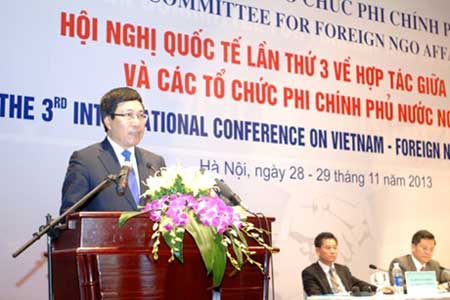
Vietnam and foreign non-governmental organisations (NGOs) have outlined directions for bilateral ties during thematic seminars in Hanoi on November 28 as part of the third international conference on Vietnam and NGOs cooperation.

Deputy PM, FM Pham Binh Minh attends the third International Meeting on cooperation between Viet Nam and NGOs, Ha Noi, November 28, 2013 - Photo: VGP
On education, both sides will focus on supporting teachers’ training in all levels, building education infrastructure system, education exchanges, assisting in foreign language training and providing voluntary teachers for specialised schools.

Also on the focus is the assistance in information technology for schools, especially those in rural, remote and mountainous areas, the intensive training for school students in social vices and the support in clean water and environmental sanitation at school.

Social issues will continue to be the cornerstone of cooperative projects with NGOs, focusing on poverty reduction, social welfares for children, the poor, vulnerable groups and ethnic minority people, and the enhancement of proactive engagement of local people as well as Vietnamese partners.

NGOs’ cooperation in environmental protection and climate change response will target the greater involvement of the private sector in emergency aid.

A seminar on the Agent Orange/Dioxin issues and support for the victims highlighted measures to further speed up the handling of AO aftermaths and improving the living conditions for the victims.

In another seminar on overcoming the consequences of unexploded ordnances in Vietnam, stronger cooperation mechanisms between Vietnam and the foreign NGOs were proposed.

Participants also shared their experience and lessons learnt in the field over the past years, while giving positive initiatives to better the work, thus eliminating the risk of losing lives to unexploded ordnances.

On vocational training and employment, connections between Vietnam and foreign NGOs will be centred on the training of vocational teachers and the transfer of modern training models.

During a seminar on health care, foreign NGOs suggested the Vietnamese side establish a healthcare working group to process their proposals and advices. They also proposed further simplifying administrative procedures and completing management mechanisms to manage and use their resources.

According to the Committee for Foreign NGO Affairs, Vietnam has established ties with around 950 foreign NGOs.

Over the past decade, NGOs have implemented more than 25,000 programmes, projects and aid packages totalling some 2.4 billion USD, with over 1.12 billion USD coming from North America, 813 million USD from Europe and more than 450 million USD from Asia-Pacific.

The assistance, which makes up 0.21 to 0.45 percent of Vietnam’s gross domestic product (GDP), has reached all 63 cities and provinces in the country.

Improving legal environment for NGOs

The Vietnamese Government committed to improving the legal environment to make it easier for Non-Governmental Organizations (NGOs)’ activities.

Deputy PM and FM Pham Binh Minh made the statement at the third International Meeting on cooperation between Viet Nam and NGOs in Ha Noi on November 28.

In the recent years, Viet Nam has gained a number of achievements following its renovation process, boosted the national industrialization and modernization, and improved the people's living standards and social welfare, the Deputy PM affirmed.

Thanks to successes in economic growth rate and social welfare, Viet Nam has fulfilled the United Nations Millennium Development Goals for poverty reduction earlier than scheduled, he added.

The proportion of poor households decreased from 13.7% in 2008 to 9.6% in 2012. The average income of poor households increased two folds over the past five years. In 2012, the number of poor households reduced 27.6% and the nation’s poor household proportion down 1.76% compared to 2011.

In external relations, the relationship between Viet Nam and other nations, international and regional organizations and NGOs have been expanded and diversified in the spirit of “Viet Nam-a reliable partner and a responsible member in the international community”.

Deputy PM Minh highlighted assistance of NGOs and international partners for Viet Nam and said he hoped that NGOs will provide more aid for Viet Nam in the future.

Priorities proposed at the meeting

Firstly, NGOs will strengthen effective cooperation in their potential fields to be suitable with Viet Nam’s demands and law.

Secondly, NGOs cooperate with Viet Nam’s agencies and localities to establish and launch realistic projects oriented to socio-economic development such as health and education services improvement, epidemic diseases prevention, social issue settlement, environmental protection, natural calamity reduction and the overcoming of wartime consequences.

Thirdly, NGOs expand their assistance by launching long-term projects and sustainable aid, increasing knowledge and skills for staffers working in fields of development and poverty reduction.

Fourthly, NGOs strengthen cooperative mechanisms with Viet Nam’s agencies and localities, especially the trilateral cooperative mechanism with local authorities and citizens.

Source: VNA

Tuesday, July 30, 2013

Technology Capacity Building for Nonprofits in Vietnam


In May, Microsoft Vietnam hosted more than 100 non-governmental organisation (NGO) representatives, including those from a number of youth-focused social enterprises in the country, at its second NGO Connection Day held in Hanoi.

“Cloud computing is changing the way NGOs work and communicate through technology networks. The second NGO Connection Day provided the participants with ample opportunities to learn from industry experts, share knowledge and discuss best practices – and the event would not have been possible if these organisations weren’t willing to share their knowledge and experience with others in the sector,” said Nguyen Thu Hue, Director of Vietnet ICT, one of the event participants.

The event was aimed at providing NGOs with deeper insights into how emerging information technology (IT) trends are shaping the future of the nonprofit sector, as well as introducing the participants to a wide array of Microsoft offerings such as Office 365®, ExchangeTM, SharePoint®, Lync® and Windows® 8 to address their operational challenges. Key topics discussed during NGO Connection Day in Hanoi included cloud computing developments, the use of social media to improve community outreach, mobility trends and Big Data.

Another highlight of NGO Connection Day was the official launch of the TechSoup Asia programme in Vietnam, which helps nonprofits in the country gain easier access to Microsoft products and other technology platforms to build their information technology (IT) capacity. At the event, the participating NGOs were provided with information about how to register.

“The challenges faced by NGOs working in Vietnam are similar to those of others around the world. The TechSoup programme will provide NGOs in Vietnam with the necessary IT resources to support the effective use of technology to address social challenges,” said Mike Yeaton, Vice President, TechSoup Asia. 

Vu Minh Tri, Country Manager of Microsoft Vietnam, said, “This NGO Connection Day event marked the official launch of TechSoup Asia in Vietnam, reinforcing our shared purpose of enabling improved access to relevant and affordable technology. Microsoft will further expand on our efforts to help NGOs and businesses alike acquire various technology resources and build technology capacity for the nonprofit sector in Vietnam.”

Source: Microsoft

Monday, August 20, 2012

Chemical Warfare: Agent Orange in Vietnam

AUGUST 10, 2012, AT NOON: 51 YEARS AFTER THE CHEMICAL WAR BEGAN IN VIETNAM, WE SHOULD BE SILENT IN MEMORY, THEN TAKE ACTION TO REMEDY

To take action go to http://www.vn-agentorange.org/

There are images from the U.S. War against Vietnam that have been indelibly imprinted on the minds of Americans who lived through it. One is the naked napalm-burned girl running from her village with flesh hanging off her body. Another is a photo of the piles of bodies from the My Lai massacre, where U.S. troops executed 504 civilians in a small village. Then there is the photograph of the silent scream of a woman student leaning over the body of her dead friend at Kent State University whose only crime was protesting the bombing of Cambodia in 1970. Finally, there is the memory of decorated members of Vietnam Veterans Against the War testifying at the Winter Soldier Hearings, often in tears, to atrocities in which they had participated during the war.

These pictures are heartbreaking. They expose the horrors of war. The U.S. War against Vietnam was televised, while images of the wars in Afghanistan and Iraq have intentionally been hidden from us. But what was not televised was the relentless ten years (1961-1971) of spraying millions of gallons of toxic herbicides over vast areas of South Vietnam. These chemicals exposed almost 5 million people, mostly civilians, to deadly consequences. The toxic herbicides, most notably Agent Orange, contained dioxin, one of the most dangerous chemicals known to man. It has been recognized by the World Health Organization as a carcinogen (causes cancer) and by the American Academy of Medicine as a teratogen (causes birth defects).

From the beginning of the spraying 51 years ago, until today, millions of Vietnamese have died from, or been completely incapacitated by, diseases which the U. S. government recognizes are related to Agent Orange for purposes of granting compensation to Vietnam Veterans in the United States. The Vietnamese, who were the intended victims of this spraying, experienced the most intense, horrible impact on human health and environmental devastation. Second and third generations of children, born to parents exposed during the war and in areas of heavy spraying — un-remediated “hot spots” of dioxin contamination, — suffer unspeakable deformities that medical authorities attribute to the dioxin in Agent Orange.

The Vietnamese exposed to the chemical suffer from cancer, liver damage, pulmonary and heart diseases, defects to reproductive capacity, and skin and nervous disorders. Their children and grandchildren have severe physical deformities, mental and physical disabilities, diseases, and shortened life spans. The forests and jungles in large parts of southern Vietnam were devastated and denuded. Centuries-old habitat was destroyed, and will not regenerate with the same diversity for hundreds of years. Animals that inhabited the forests and jungles are threatened with extinction, disrupting the communities that depended on them. The rivers and underground water in some areas have also been contaminated. Erosion and desertification will change the environment, causing dislocation of crop and animal life.

For the past 51 years, the Vietnamese people have been attempting to address this legacy of war by trying to get the United States and the chemical companies to accept responsibility for this ongoing nightmare. An unsuccessful legal action by Vietnamese victims of Agent Orange against the chemical companies in U.S. federal court, begun in 2004, has nonetheless spawned a movement to hold the United States accountable for using such dangerous chemicals on civilian populations. The movement has resulted in pending legislation HR 2634 – The Victims of Agent Orange Relief Act of 2011, which attempts to provide medical, rehabilitative and social service compensation to the Vietnamese victims of Agent Orange, remediation of dioxin-contaminated “hot spots,” and medical services for the children and grandchildren of U. S. Vietnam veterans and Vietnamese-Americans who have been born with the same diseases and deformities.

Using weapons of war on civilian populations violates the laws of war, which recognize the principle of distinction between military and civilian objects, requiring armies to avoid civilian targets. These laws of war are enshrined in the Hague Convention and the Nuremberg principles, and are codified in the Geneva Conventions of 1949 and the Optional Protocol of 1977, as well as the International Criminal Court statute. The aerial bombardments of civilian population centers in World Wars I and II violated the principle of distinction, as did the detonation of nuclear weapons at Hiroshima and Nagasaki on August 6 and August 9 of 1945. Hundreds of thousands of Japanese people were killed in an instant, even though Japan was already negotiating the terms of surrender.

The use of Agent Orange on civilian populations violated the laws of war and yet no one has been held to account. Taxpayers pick up the tab of the Agent Orange Compensation fund for the U. S. Veterans at a cost of 1.52 billion dollars a year. The chemical companies, most specifically Dow and Monsanto, which profited from the manufacture of Agent Orange, paid a pittance to settle the veterans’ lawsuit to compensate them, as the unintended victims, for their Agent Orange related illnesses. But the Vietnamese continue to suffer from these violations with almost no recognition, as do the offspring of Agent Orange-exposed U.S. veterans and Vietnamese-Americans.

What is the difference between super powers like the United States violating the laws of war with impunity and the reports of killing of Syrian civilians by both sides in the current civil war? Does the United States have any credibility to demand governments and non-state actors end the killings of civilians, when through wars and drones and its refusal to acknowledge responsibility for the use of Agent Orange, the United States has and is engaging in the very conduct it publicly deplores?
In 1945, at the founding conference of the United Nations, the countries of the world determined:
to save succeeding generations from the scourge of war, which twice in our lifetime has brought untold sorrow to mankind, and to reaffirm faith in fundamental human rights, in the dignity and worth of the human person, in the equal rights of men and women and of nations large and small, and
to establish conditions under which justice and respect for the obligations arising from treaties and other sources of international law can be maintained, andto promote social progress and better standards of life in larger freedom.

If we are to avoid sinking once again into the scourge of war, we must reaffirm the principles of the Charter and establish conditions under which countries take actions that promote rather than undermine justice and respect for our international legal obligations. The alternative is the law of the jungle, where only might makes right. It is time that right makes might.

August 10th marks 51 years since the beginning of the spraying of Agent Orange in Vietnam. In commemoration, the Vietnam Agent Orange Relief and Responsibility Campaign urges you to observe 51 seconds of silence at 12 noon, to think about the horrors of wars which have occurred. We ask you to take action so as not to see future images of naked children running from napalm, or young soldiers wiping out the population of an entire village, or other atrocities associated with war, poverty, and violence around the world. We urge you to take at least 51 seconds for your action. In the United States, you can sign an orange post card to the U.S. Congress asking it to pass HR 2634. This would be a good start to assist the Vietnamese victims of Agent Orange as well as the next generations of those exposed to these dangerous chemicals in both Vietnam and the United States.
Jeanne Mirer, a New York attorney, is president of the International Association of Democratic Lawyers. Marjorie Cohn is a professor at Thomas Jefferson School of Law and former president of the National Lawyers Guild. They are both on the board of the Vietnam Agent Orange Relief and Responsibility Campaign.

To sign the petition, go to http://www.vn-agentorange.org/ 

Source: http://www.globalresearch.ca/chemical-warfare-agent-orange-in-vietnam/32227

Sunday, September 9, 2007

Innovative Approaches to Flood Risk Reduction in the Mekong Basin

A two-day Regional Workshop on Innovative Approaches to Flood Risk Reduction in the Mekong Basin on 17-19 October 2007 in Thailand, which is being jointly organized by MRC and ADPC with funding support from Die DeutscheGesellschaft für Technische Zusammenarbeit (GTZ) GmbH

The workshop objectives are to:
- Share local and regional knowledge, experiences and innovations in flood risk reduction approaches;
- Provide a platform to foster new regional partnerships as well as strengthen the existing ones to promote flood risk reduction in the region

In this regard we would request any organizations interested to participate in this workshop.

For further inquiries on the Workshop, please visit:
http://www.adpc.net/regionalworkshop.asp
and contact: E-mail: regionalworkshop@gmail.com

For more information on FEMS please contact:
Mr. Thanongdeth Insisiengmay, ADPC Program Manager
MRC’s Regional Flood Management and Mitigation Centre (RFMMC)
364 Monivong Blvd. Phnom Penh, Cambodia
Tel.: 855-23 726 622, Fax: 855-23 726 633

Globalization, Regional Development & Local Initiatives

This conference will be held from 25 November to 2 December 2007


The Weitz Center for Development Studies, founded in 1963, has been engaged since its establishment in local and regional development planning in Israel and, within the framework of MASHAV (Center for International Cooperation, Ministry of Foreign Affairs of Israel).

More than 3,000 professionals have taken part in the Weitz Center training programs, whose objective is to enhance the ability of participants to improve conditions in underdeveloped regions of their countries through an integrated development strategy and the application of appropriate methodologies for planning and implementation.
Please click here for more information

Energy, Environment, Climate Change and Sustainable Development

13th ASEAN Summit People Singapore "Energy, Environment, Climate Change and Sustainable Development" is a key theme of discussions at the upcoming 13th ASEAN Summit and its related meetings in Singapore held in November 2007.


At the 40th ASEAN Ministerial Meeting held in July 2007 in Manila, the ASEAN Foreign Ministers also welcomed Singapore's proposal, as the Chair of ASEAN to focus on "Energy, Environment, Climate Change and Sustainable Development as a key theme of discussions at the upcoming 13th ASEAN Summit and its related meetings in Singapore held in November 2007. In line with this theme, we look forward to the ASEAN Leaders' Declaration on Environmental Sustainability to be signed at the 13th ASEAN Summit and a proposal to work on a Singapore Declaration on the Environment to be issued at the 3rd East Asia Summit.

The Association of Southeast Asian Nations or ASEAN was established on 8 August 1967 in Bangkok by the five original Member Countries, namely, Indonesia, Malaysia, Philippines, Singapore, and Thailand. Brunei Darussalam joined on 8 January 1984, Vietnam on 28 July 1995, Lao PDR and Myanmar on 23 July 1997, and Cambodia on 30 April 1999.

The ASEAN region has a population of about 500 million, a total area of 4.5 million square kilometers, a combined gross domestic product of almost US$ 700 billion, and a total trade of about US$ 850 billion.
For further enquiries on media accreditation:

The Strength of Many, the Heart of One

The Vietnamese American NonGovernmental Organizations (VA NGO) Network is proud to announce the Third VA NGO Conference from September 28 - 30, 2007 in San Diego, California.

Since the first conference in 2004, the Network continues to attract more partners, groups and individuals who are working with the common mission to improve and save the lives of disadvantaged Vietnamese. The Conference actively seeks the participation of multiple generations of Vietnamese living both in Vietnam and elsewhere in the world. We invite you, our colleagues, who are organizations, groups, and individuals that fund, support or operate projects in Vietnam, to come share and learn at this conference.

At this conference, we will:
- report Network activities and achievements since Sonoma 2005 Conference
- enlist and partner with the next generation of humanitarian and development workers
- showcase members collaborative efforts and tools, and
- provide capacity building workshops on fundraising, financial efficiency, and program implementation.

The conference fee covers lodging and all meals. We encourage participants to attend the entire conference and remain on-site. VA NGO Network members will receive special discounts for registrations.

To become a member, please refer to the Membership link at http://www.va-ngo.org/

The Conference Planning Committee, consists of
- Catalyst Foundation http://www.catalystfoundation.org/
- Children of Peace International http://www.childrenofpeace.org/
- Kids Without Borders http://www.kidswithnoborders.org/
- Our 1 World http://www.our1world.org/
- Pacific Links Foundation http://www.pacificlinks.org/
- Vietnamese American Nurse Association

For more information about the VA NGO Conference, please contact us at
conference@va-ngo.org

Tuesday, July 10, 2007

Vietnam's international integration goes online

Source: Nhan Dan

Students in the capital city of Hanoi and southern economic hub of Ho Chi Minh City on June 26 went online to discuss environmental issues with Japanese and Australian peers, reported the Vietnam News Agency from Ho Chi Minh City.

The e-conference was only the start of a series of activities to be launched by development learning centres in the two cities, which were members of the Global Development Learning Network. The network, an initiative of the World Bank to facilitate online dialogue, discussion and study, has so far connected more than 110 centres of its kind in 80 countries worldwide.

At present, there are only two development learning centres in Vietnam, one in Hanoi and the other in Ho Chi Minh City.

The World Bank was the main sponsor of the two centres. The other supporters included the governments of Australia, Canada and Denmark, according to Laurent Msellati, WB's acting country director in Vietnam.

"These centres reflect our commitment to fostering knowledge sharing and development, by facilitating exchanges between Vietnamese policy makers, academics and experts and their international counterparts," said Msellati.

Freshly inaugurated on June 26, the Ho Chi Minh City Development Learning Centre will offer Internet-based education initiatives and host seminars and global policy dialogues that cover a wide range of development topics, in partnership with local Vietnamese institutions, said Vo Cong Anh, manager of the centre.

It will also make use of its links with the network and the World Bank's support to help local businesses reach out to new markets.

Friday, May 25, 2007

2030 club ready for second charity-business caravan tour

The 2030 Businessmen Club will organize a second caravan tour featuring charity, business and holiday activities for its members and other clubs from May 24 to 27.

Nguyen Hoai Nam, chairman of the club, a member of the Saigon Times Club, told reporters in HCMC yesterday some 100 business people would travel on 40 cars through more than 1,000 kilometers from Vietnam to Cambodia.

The tour will start in HCMC and take in Moc Bai Border Gate in Tay Ninh Province of Vietnam, and Phnom Penh on the first day. The participants will visit the Royal Palace and other tourist attractions in the Cambodian capital before meeting the Vietnamese business community in Cambodia at the premises of the Vietnamese embassy.

The meeting is for participants to build links and explore business opportunities through their counterparts in Cambodia.

The business people will present scholarships, books, instant noodle, clothes and other necessities of life to poor Vietnamese students of the first and third graders on Ton Le Sap lake in Siem Reap. They will donate some VND30 million as teaching fees over two years to the teachers who help the poor pupils.

Visits to Angkor Wat and other places of interest in Cambodia are part of the caravan tour, which the 2030 Businessmen Club is organizing in collaboration with VYC Travel and advertising firm HTC.

Nam said the club was taking registrations from business people to participate in the tour, and calling for the business community to make donations in cash or kind for the poor the club will help during their trip in Cambodia.

Saigon Times Club manager Quoc Vinh said the 2030 club organized the first Vietnam-Cambodia caravan tour after the success of the caravan tour through Binh Phuoc, Dak Nong and Daklak provinces last year.

Participating business people of last year’s caravan tour donated 300 gifts and 25 wheelchairs to the needy in the provinces. Accompanying doctors and nurses also examined 200 patients and donated medicines.

Vinh said the caravan tour and the futsal tournament were among the annual activities the 2030 Businessmen Club held to benefit its members and the community.

The 2030 club, which was established in 2002, now has more than 200 members. The club and Saigon Times Group have successfully hosted futsal tournaments for companies and organizations, special events for the club’s members to share business and entertainment experiences, and charity events to collect money for Orange Agent and natural disaster victims and poor yet industrious students.

Source: Saigon Times Daily

Saigon Cyclo race wheels in $60,000 for charity

The Sai Gon Children's Charity's seventh annual Sai Gon Cycle Challenge was the largest ever as over 3,000 people watched nearly 50 company teams compete at the Sai Gon South Roller Skating Rink last Saturday.

The charity estimated that it raised more than US$60,000 - 10% of its expected annual income - through over 90 sponsors. The money will go towards building new schools, developing a recently established school for the deaf, granting scholarships, providing vocational training and offering microfinance options for the rural poor.

The internationally corporate-sponsored event reflected the growing commitment of the business and local community to participate in large non-profit charity events that rely on co-operation and volunteer work. The crowd was the kind of mix becoming more common in Vietnam, a mix of both foreigners and Vietnamese, both executives and entry-level employees.

The company teams, made up of employees from the local and foreign businesses in Vietnam, raced in five-relay heats that required teamwork to overcome various off-track physical challenges and obstacle courses.

An additional heat was run, with real-life cyclo drivers representing the teams. The race brought together two very different Vietnam's as CEOs drove cyclos and real cyclo drivers became corporate advertisers.

The first and second place winners of each race then competed in the final Grand Prize Race. The Duxton Hotel team won first place for the second year in a row while Adidas Team 3 took second place and The Canadian Chamber of Commerce (Cancham) came in third.

In addition to the races, a Grand Sponsors Parade provided the event's largest sponsors the opportunity to put on a show with marching bands, cheer-leaders, costumed dancers, decorated cyclos, banners and floats.

HSBC went all out to win the Best Cheerleading prize with its carnival-esque outfit of fire jugglers on unicycles and exotic dancing girls.

Smiles abounded and the day went off without a hitch as everyone, even the usually stressed out organisers, had a blast. "This is the first time I've really been able to completely enjoy the whole event," said Director of the Sai Gon Children's Charity Paul Cleves, who has also chaired the event for five years.

"We've had hassles in the past but there we haven't had any problems this year. This is a really really good time. Brilliant."

Although there were some near spills on the rickety cyclos, the first aid booth was quiet and the event was an enjoyable success.

Source: Viet Nam News

Sunday, May 20, 2007

Religious Innovation in East Asia

This conference will be held on 28 - 30 November 2007 in Australia


In the last few decades, the religious scene across East Asia has changed in fundamental ways. Changes in government administration, communications technologies, the degree of urbanisation, levels of education, and increasing wealth have run parallel to a burgeoning of religious life. These years have seen a growth in new religious movements, new varieties of existing religions and new forms of religiosity. They have also seen an increased public presence and awareness of religious groups through involvement in mainstream politics, in opposition to the state, and by violent interventions as well as simply becoming more visible on the streets, in the media and on the web.

This conference seeks to explore these changes in China (including Taiwan, Hong Kong and Macau), Japan, South Korea and Vietnam and amongst their diasporic communities, and the background to them. Some of the themes on which papers may be suggested are:
- New religious movements
- New formations of Buddhism, Islam and other established religions
- Cultivation and self-cultivation, especially qigong and related activities
- Religious innovation in the diasporas
- Theoretical and methodological issues related to religious innovation
- Popular religion in contemporary societies

Major speakers will be invited from China, Japan and South Korea.

Suggestions for papers should be submitted to Anthony.Garnaut@anu.edu.au by May 31, 2007. Some travel funding is likely to be available for participants, including graduate students, from Australia and New Zealand.

The Role of Non-Timber Forest Products (NTFPs) in Poverty Alleviation and Biodiversity Conservation

The conference will be held on 11 - 15 June 2007, Sofitel Plaza Hotel, Hanoi, Vietnam

Background:
Non-Timber Forest Products (NTFPs) play an important role in the livelihoods of the rural poor, as a source of food, medicine, construction materials, and income. It has been estimated that there are more than 60 million highly forest-dependent people in Latin America, West Africa, and South East Asia, with an additional 400 million to 500 million people directly dependent on these natural products.

The Conference:
The Conference will be hosted by the NTFP Sub-Sector Support Project, the Ministry of Agriculture and Rural Development (MARD), and the World Conservation Union (IUCN), The Netherlands Development Organisation (SNV), The German Technical Cooperation (gtz), CARE International, the World Wide Fund for Nature (WWF), The Regional Community Forestry
Training Center for Asia and the Pacific (RECOFTC) and The Swiss Import Promotion Programme (SIPPO). It will bring together practitioners, entrepreneurs and researchers who are involved in NTFP initiatives that provide opportunities to address poverty reduction while maintaining biodiversity. Participants will share methodologies, approaches, product and market information and other lessons learned from NTFP development and conservation initiatives. The trade fair on the fourth day of the conference will provide an opportunity for NTFP producers to display their products and meet potential buyers.

Programme:
- June 11: Sessions on “Critical Elements for Successful NTFP Initiatives”
- June 12: Sessions on “Critical Elements for Successful NTFP Initiatives” (continued)
- June 13: Sessions on “The Business of NTFPs”
- June 14: NTFP Trade Fair
- June 15: NTFP Field Site Visit

Presentations:
- Papers: If you are interested in presenting a paper at the conference, please contact the Conference Contact Persons immediately for further information.
- Posters: There will be display areas for posters and documents. Please let us know by Monday, May 21^st if you would like to have a space for a display.
- Trade Fair: If you are interested in displaying your products at the trade fair please contact the Conference Contact Persons for registration forms and materials by Monday, May 21st . There is no fee to participate in the trade fair.

Registration:
A registration fee of $150 will be charged to International Participants ($50 for students). The fee will cover access to all conference events, documents, trade fair, coffee/tea breaks, lunches, a reception on the first day, and the field site visit. To register for the conference please complete the Registration Form and send it to the Conference Contact Persons by Monday, May 28th .

Conference Contact Persons:
Sarah Webster - Programme Assistant
IUCN Vietnam and NTFP Sub-Sector Suppor Project
44/4 Van Bao
Ba Dinh District, Hanoi
Office: 7.261.575/6 Ext. 133
Mobile: 0904 663 702

Monday, May 7, 2007

Biodiversity and Climate Change: Links with Poverty and Sustainable Development

The German Development Cooperation (GTZ/DED) on behalf of the German Federal Ministry for Economic Cooperation and Development (BMZ), in cooperation with the Vietnamese Ministry for Natural Resources and Environment (MoNRE) and the Secretariat of the Convention on Biological Diversity (CBD) as well as other national and international partners organise this conference from May 22-23, 2007 in Ha Noi


Session's titels of the full 2-day-Conference are:
- Challenges of Climate Change and Biodiversity Loss for South East Asian Countries: Links to Poverty and Sustainable Development
- Impacts of Climate Change and Biodiversity Loss on Different Economic Sectors
- Integrating Biodiversity Conservation and Climate Change Aspects in National and Sectoral Strategies in Vietnam
- Regional and Local Approaches on Climate Change Adaptation and Biodiversity Conservation / Case Studies
- Mainstreaming Climate Change Adaptation and Biodiversity Conservation in Donor Strategies

The conference provides a forum for decision makers, researchers, development agencies, non-governmental organisations and the concered public to exchange expertise and experiences in the regional context, discuss and assess emerging adaptation strategies and to provide a platform for networking and collaboration among relevant actors.

The conference is interlinked with the Biodiversity Action Day in Tam Dao National Park on May 19 that gives visitors from all walks of life a direct experience of nature and the opportunity to experience biodiversity conservation and climate change issues in a practical context. A series of cultural and artistic performances accompany the events.

Please find attached several documents relating to the upcoming events:

Contact details:
Ines Igney
Email: inesig@gmail.com
Mobile : +84 (0) 917511447
Tel.: +84 (0) 4 9344951
Tel. direct:+84 (0) 4 936 2280 - 124
Fax: +84 (0) 4 934 4950

Disabled kids get special visit

The wife of the Lord Mayor of the City of London, Lesley Stuttard, visited a school for children with disabilities in Hanoi on May 3 as part of a charity drive.

In Sao Mai (Morning Star) School, Lady Stuttard, along with the wife of London’s Sheriff, joined more than 1,000 mentally disabled children from 18 months to 16 years. There, she doled out specially-designed toys that promote learning.

“I am impressed by what I see, particularly the number of staff in comparison to the number of children and dedication of those staff,” she said. “The idea of early intervention by their parents in crucially important.”

The tour was part of the Lord Mayor Appeal, an initiative that sees the head of England’s biggest City Corporation support charities.

During her visit to Vietnam, Stuttard’s schedule was filled with activities related to education for disabled children, including visits to the Special Education Faculty of Teachers’ Training College at the National University in Hanoi and Ho Chi Minh City’s Research and Education Centre for Disabled Children.

Stuttard said she hoped the number of special education schools would increase.

Not many Vietnamese children with disabilities go to school. In Hanoi, only 30% of disabled children attend classes, according to Do Thuy Lan, director of Sao Mai School and member of a national association for disabled children.

Source: VNA

National environmental week launched

A meeting was held in Vinh Yen town, the northern midland province of Vinh Phuc, on May 4 to launch the national week for safe water and environmental hygiene.

The national week for safe water and environmental hygiene called on all sectors and localities to raise the people’s awareness about the importance of environmental hygiene, safe water management, and protection of water sources.

It also draws the people’s attention to the need of waste management, particularly waste from industrial parks, in order to ensure safe water and environment.

After the meeting, participants joined the local people to organise parades along major streets in Vinh Yen and plant trees in the surrounding areas.

The meeting, jointly held by the National Steering Board on Safe Water and Environmental Hygiene, the Natural Resources and Environment Ministry, the Vietnamese Farmers’ Association, the Committee for Ethnic Minority and the provincial People’s Committee, drew the participation of some 3,000 local people.

Source: VNA

Monday, April 30, 2007

Vietnam Joins International Convention on Rights of People with Disabilities

Vietnam has more than 5.3 million people with disabilities, accounting for 6.4 percent of its total population. Of this total, about 69 percent are of working age. Disabled people have the rights to healthcare services, education, and cultural and vocational training activities which will aid them in seeking employment, receiving equal treatment and fully integrating into the community.


The United Nations General Assembly, on December 13, 2006, adopted the International Convention on the rights of people with disabilities. The convention is the first global document in human history, affirming the rights of disabled people. It asserts that disabled people are recognized as having full rights and human dignity, like other members of our communities and should enjoy equal treatment and opportunities in society. In addition, on March 20, 2007, in New York, as many as 81 UN-member countries signed up to the convention.

At present, Vietnam has more than 5.3 million people with disabilities, accounting for 6.4 percent of its total population. It’s worth noting that about 69 percent of disabled people are of working age. Disabled people need suitable and comprehensive healthcare services, education, and cultural and vocational training activities in order to aid them in seeking employment, receiving equal treatment and fully integrating into the community.

Currently, Vietnam has adopted policies on disabled people with regulated documents showing due attention of the Party and State to disabled people, such as the ordinance on disabled people, issued in 1998, the Labour Code, the Law on Education, the Law on Information Technology and the Law on Vocational Training, which all have special articles mentioning disabled people. As planned, the Ministry of Labour, Invalids and Social Affairs will develop the Law on disabled people to submit to the National Assembly for approval in 2008.

In the Asia-Pacific region, Vietnam’s efforts in supporting the disabled have been in the international spotlight. The country has formulated a project to help the disabled in the 2006-2010 period, which was approved by the Prime Minister by decision No 239/2006/QD-TTg, dated October 24, 2006. The National Coordinating Council on Disabilities (NCCD) including 17 ministries and agencies and various organizations for the disabled has so far operated effectively, contributing to raising people’s awareness. Vietnam is implementing its commitments to the Millennium Framework for Action towards an Inclusive, Barrier-free and Rights-based Society for Persons with Disabilities in Asia and the Pacific (2003-2012).

The Ministry of Labour, Invalids and Social Affairs has asked the Ministry of Foreign Affairs, the Ministry of Justice, the Ministry of Education and Training, and the Ministry of Public Security to conduct research and give opinions on Vietnam’s participation in the International Convention on the rights of people with disabilities. Relevant ministries agreed that the content of the convention is in accordance with the Party and State’s policies and reflects Vietnam’s committements to ensuring all human rights and essential needs to eliminate discrimination against people with disabilities.

Director of NCCD, Nghiem Xuan Tue said, once Vietnam signs the convention, it proves that the Government of Vietnam respects the rights of disabled people.

Tuesday, April 3, 2007

Bill Gates does charity in Vietnam

Microsoft Chairman and his wife visited a health station in the outskirt of Hanoi Monday morning. That’s the health station of Trung Mau Commune, Gia Lam District, where receives aid from the Bill & Melinda Gates fund for vaccinations.


Vu Thi Oanh, chief of the Trung Mau commune health station, said that April 2 was the day for vaccination of seven types of vaccines for children from 0-12 months.


During two hours (8-10am) in Trung Mau commune, Bill Gates, Melinda Gates and Vietnamese health officials inspected the vaccination, management task and working procedures of the health station.


Bill Gates and his wife directly witnessed the operations of doctors and nurses and the vaccine maintenance equipment at the health station.


They also came to some local families to ask about the extended vaccination programme in the commune and to see how is the health of local women and children.


At 6.15pm of April 2, Bill Gates met with officials of the Ministries of Health, Finance and Planning and Investment at the Hilton Hotel to talk about funding for Vietnam.


At a party held by Bill Gates and his wife, Deputy Minister of Health Trinh Quan Huan proposed Bill & Melinda Fund to provide vaccines for the extended vaccination programme of Vietnam as well as support the HIV/AIDS control programme in the country.


In a talk with reporters, Mr Huan said that Bill Gates highly appreciated the expanded vaccination programme of Vietnam.


Today, April 3, Bill Gates and his wife will meet with Prime Minister Nguyen Tan Dung and worked with the Central Hygiene and Epidemic Prevention Institute on vaccination programmed funded by the Bill & Melinda Gates Fund. They signed a project worth $245,000 to vaccinate HPV to prevent cervical cancer for around 800 girls from 11-13 years old.


HPV is the only cancer prevention vaccine used in 59 countries. This kind of vaccine may be officially sold in Vietnam this year’s end. However, it is difficult to spread the use of this vaccine since its price is high, around $100/injection while each woman needs up to three shots.


Source: VietNamNet