Sunday, June 3, 2012

Ethnic Minorities Need Stronger Voice in Public Policy on Poverty

Ahead of next Monday's Consultative Group meeting on breakthroughs in poverty reduction, Oxfam's associate country director Bert Maerten talks about the importance of local voices in achieving poverty reduction. Lives have improved tremendously in rural areas during the last decade, even in remote and mountainous areas. Prior to 2007, women in Ban Lien, a remote commune in northern mountainous Lao Cai Province, had little access to markets and the outside world. Since a market was set up in 2008, they have been able to sell surplus vegetables there. The market is also a place for information sharing and has improved channels and opportunities for communication. Such a sense of progress and achievement exists among many communities around the country. Millions have lifted themselves out of poverty. Despite such progress, opportunities seem to be bypassing a significant number of people who live in chronic poverty.

According to a joint poverty monitoring survey conducted by Oxfam and ActionAid in 10 communes nationwide, 23 per cent of those surveyed live in chronic poverty – 45 per cent or more of those in ethnic minority communities. Nationwide, 5-6 million people are estimated to be food insecure, while one of three children under five is stunted. These are far from ‘pockets' of poverty but are large swathes of the country mired in deep, intergenerational poverty. Similarly, new forms of injustice are also emerging. The manner in which opportunities, resources, risks and benefits are shared is critical in a middle-income country. As access to and control over natural resources become more valuable and contested, risks increase alongside new economic opportunities. Winners and losers are created, shifts in power occur and barriers can become more entrenched. In a more diverse economy and society, the voices of people, especially the poor and marginalized, need to be heard in order to confront exclusion and guarantee a fair distribution of opportunities and benefits. Poverty is increasingly concentrated among ethnic minorities. Minorities are five times more likely to be poor than the Kinh majority. In 2010, minorities accounted for 47 per cent of nation's total population living in poverty and two-thirds of those in the poorest 10 per cent of the population. Understanding sources of such inequality, including patterns of social exclusion, discrimination and stigma, will be crucial in order for public policy responses to be more effective. For example, ethnic minorities suffer from poorer quality services, such as health education and infrastructure.

They consistently have poorer quality land allocations, even when statistics show they have more land. Restrictions on access to forest lands has had enormous impacts on some ethnic minority communities. But important innovations in public policy are already underway or being explored. The social security strategy offers opportunities to better target and tailor household assistance. Cash transfers are being considered and piloted, while block grant allocations to authorities in poor areas should enable better decisions about what investments and approaches are needed to address local poverty. We have also seen important changes in the media, although other shifts are needed to overcome the exclusion of ethnic minorities.

Stronger and genuinely participatory processes need to be instituted that enable discussion, debate, and advocacy of ethnic interests. A broader dialogue about the role of culture in poverty reduction and development is important. The ability for a people and nation to reflect on and question the various forms and causes of exclusion is one of biggest challenges facing the achievement of a prosperous and just society. But it is through this that the fight against poverty and injustice will ultimately be won.

Source: Vietnam News

Saturday, June 2, 2012

EU Pledges to Provide $1B ODA for Vietnam This Year

The European Union (EU) has pledged to provide EUR745.3 million ($1 billion) worth of official development assistance (ODA) for Vietnam in 2012, accounting for 13.24% of the total pledged by international donors for the country. Ambassador Franz Jessen, who is Head of the EU delegation to Vietnam, made the statement at the launch of the “EU Blue Book 2012,” an annual publication on EU development in Vietnam, on May 31. Of the sum, non-refundable aid makes up 32.5%, or EUR245.21 million, Jessen said, highlighting that EU remains one of the leading ODA providers for Vietnam. He hoped that the EU’s grants and loans to Vietnam will stimulate policy changes and growth in targeted areas, including public finance management and economic reform, private sector development, poverty reduction, administration, social affairs and technology.

The diplomat said the Vietnam-EU relations have been expanded beyond development cooperation programs. Amid the economic crisis in Europe in particular and in the globe in general, the EU’s remarkable committed assistance to Vietnam has reflected the importance of the Vietnam-EU relations, he said. The ambassador described the upcoming signing of the Vietnam-EU Partnership and Cooperation Agreement (PCA) this year as a manifestation of the wide and unceasingly developing cooperation between the bloc and Vietnam.

The EU has become Vietnam’s second biggest trade partner with the two-way trade stood at EUR18 billion in 2011, including the latter’s trade surplus of EUR7.6 billion. Vietnam and the EU plan to start the first round of a Free Trade Agreement (FTA) negotiation between July and September 2012.

Source: VOV

Friday, June 1, 2012

Dutch NGO Supports Vietnam Farmers to Grow Tea, Cardamom

A seminar was held in the Vietnamese northern province of Lao Cai on May 29 to review the growing of tea and cardamom in Lao Cai, Lai Chau and Ha Giang provinces, funded by the Dutch development organization SNV. After being in operation for five years, from 2008-2012, the project has helped over 7,000 cardamom growing households to increase productivity, and raise their incomes by 15%-20%. The Dutch non-governmental organization has also helped to link up farmers and businesses with each other. Under the program, Lao Cai province developed a 35 hectares organic tea plantation in Bao Thang district. SNV provided support for trade promotions and helped to introduce cardamom to South Korea and Japan. Thank to the SNV’s support, Lao Cai province has effectively implemented model from production to consumption, said Pham Dinh Que, deputy head of the provincial Agriculture and Rural Development Department. As part of the project, farmers now have much more capacity, Que added. The province has also applied advances in technology to production and processing to improve the quality of products to meet domestic and foreign demands.

Source: qdnd.vn

WB Pledges $4.2B for Country Partnership Strategy in Vietnam by 2016

The World Bank (WB) has pledged to fund $4.2 billion to help Vietnam implement a new Country Partnership Strategy (CPS) in the 2012-2016 period. The information was released at a working session between the WB and the Ministry of Planning and Investment (MPI) in the capital city of Hanoi on May 31. Accordingly, the soft loan, which will be channeled through the WB and the International Development Association (IDA), will focus on increasing Vietnam’s competitiveness, ensuring sustainable development and widening the access to socio-economic development opportunities. The new five-year strategy will support investments, programs and advisory services organized into a strategic framework of three pillars and three cross-cutting themes, including boosting governance; promoting gender equality; and improving resilience in the face of external economic shocks, natural disasters, and climate change impacts.

The WB Country Director in Vietnam, Victoria Kwakwa, said the new strategy is expected to contribute to effectively supervising the use of resources and enhancing operational efficiency. MPI Deputy Minister Cao Viet Sinh affirmed the significance of the new CPS, especially when the government has announced its socio-economic development strategy in the 2011-2020 period, with a focus on structural reforms, environmental sustainability, social equity, and emerging issues of macroeconomic stabilization. This is Vietnam’s largest IDA allocation, reflecting its strong performance as well as an increase in IDA resources overall. The country is also expected to have access to International Bank for Reconstruction and Development (IBRD) resources, estimated at nearly $770 million, until mid-2014. Since 1993, the WB has provided nearly $14 billion in credit, loans and grants to help Vietnam sustain growth and fight poverty. The biggest multilateral donor WB pledged $2 billion in ODA for Vietnam in 2012.

Source: Tuoi Tre

Saturday, May 26, 2012

Vietnamese AO Victims Association Visits Laos

A delegation from the Vietnamese Association of Victims of Agent Orange/Dioxin (VAVA) on May 23 met with Laotian Deputy Prime Minister, Senior Lieutenant General Douangchay Phichith, as part of their visit to Laos from May 22-24. At the meeting, the VAVA President, Senior Lieutenant General Nguyen Van Rinh, who led the delegation, informed his host about the outcomes of the meeting with the Laos Veterans Association and a number of ministries and branches in Laos. He stressed the serious impacts caused by Agent Orange (AO)/dioxin as well as unexploded bombs and mines left over from wartime. In Vietnam, the US sprayed 80 million liters of the deadly chemical on 25 percent of the area of Southern Vietnam. The toxins destroyed millions of hectares of forests and crops, directly infected millions of Vietnamese people and had repercussions for following generations. Rinh said Laos is likely to suffer from the consequence of Agent Orange/dioxin and suggested that Vietnam and Laos work together to help AO victims and join with international efforts to ask the US to take responsibility for their actions. Sharing Rinh’s views, Deputy PM Phichith, who is also Laos Defense Minister said he was extremely moved when hearing about the suffering Vietnamese AO victims go through because of the chemical. He stressed his support for Vietnam in its struggle for justice for AO victims. The two countries should join efforts to campaign against weapons of mass destruction, said the Lao Deputy PM.

Source: Vietnamplus

Friday, May 25, 2012

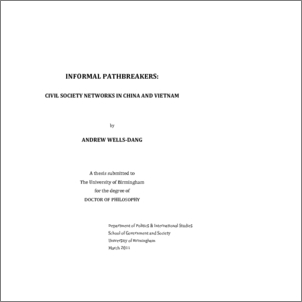
Informal pathbreakers: civil society networks in china and vietnam

This thesis re-conceptualises civil society as a process of cross-sectoral networking and alliance building among individual activists and organisations. Civil society networks are built on personal connections and develop into flexible, often informal structures that engage in path-breaking advocacy with authorities and elites. In the challenging political contexts of China and Vietnam, civil society networks have brought about significant social change. The findings of extensive fieldwork in both countries demonstrate a wider range of advocacy techniques and strategies than previously documented in one-party authoritarian political systems. Four in-depth qualitative case studies are presented to illustrate a range of network structures, histories and advocacy strategies: the Bright Future Group of people with disabilities (Vietnam), Women’s Network against AIDS (China), the Reunification Park public space network (Vietnam), and the China Rivers Network. Research questions concern how civil society networks form, how they operate, and what strategies they select to influence and interact with state actors and other stakeholders, as well as how network members evaluate the effectiveness of their actions. The thesis concludes with comparative evaluations of the case studies and recommendations for donors and international partners to support networks that form organically.

Source: http://etheses.bham.ac.uk/1631/

Directory of International NGOs working in Vietnam

The INGO Directory lists member NGOs of the VUFO-NGO Resource Centre, contact details and other information - see below.

A more detailed printed INGO Directory is also published and on sale to the public. As well as information about international NGOs and their work it provides other details, including contact details for United Nations agencies and Vietnamese Government ministries and legal documents governing the work of international NGOs in Vietnam.

Member NGOs of the VUFO-NGO Resource Centre can view the full directory online. They should log in at the bottom of this page, then click the INGO Directory button on the menu bar at the top of the page.
Comments, inquiries and updates about the online and printed versions of the INGO Directory should be submitted through the contact numbers or email at the bottom of this page.

Link: http://www.ngocentre.org.vn/ingodirectory