Monday, July 21, 2014

Local nonprofit spreads love of art and music in Vietnam


The per capita income in some poor areas of Vietnam is the equivalent of $1 per day. School children are known to walk an hour each way to school, and many don’t continue their education beyond the fifth grade.

Rock-Paper-Scissors Children’s Fund, a non-profit founded by Sara Stevens Nerone of Peace Dale, gives impoverished Vietnamese children an opportunity to explore art and music – something they may not get otherwise. This summer, her family and several South Kingstown youth volunteers will travel to Vietnam to help run the programs and teach music camps to children.

“In Vietnam, the kids, especially those living in poverty, don’t have opportunity like kids in the United States do to take music lessons,” Stevens Nerone said. “They don’t have money to buy instruments and they don’t have money to buy art supplies. So we thought this was a great way to be able to provide that opportunity to kids who have those interests.”

The group of nine will leave July 17 and return to the United States August 4. The volunteers will teach approximately 300 children in three villages, Son Tan, Suoi Cat and Cam Phuouc.

The half-day camps will focus largely on what Stevens Nerone referred to as “ethnic minorities” in the country. Vietnam has about 54 ethnic groups in different pockets of the country, but approximately 90 percent of the population are Kinh, the majority group. The remaining groups, the minority, are often the most impoverished, Stevens Nerone said. Rock-Paper-Scissors partners with the Vietnamese Red Cross to identify the areas of the country to focus on.

Rock-Paper-Scissors has a year-round program in Vietnam. The organization sponsors Vietnamese teachers, who instruct approximately 22 violin and cello students and 15 art students in the village of Cam Duc. In the summer, Stevens Nerone’s family helps with this program, and volunteers will prepare the Vietnamese students for a concert for the local government. The volunteers also will teach larger camps in the three other villages.

“When you’re playing together, everyone has something to do; everyone has a part,” said Hannah Beekman of Peace Dale, a volunteer making the trip. “The end result is something that’s really nice.”

This is the first year they will bring the small group of volunteers, all South Kingstown residents: Beekman, Kaitlin Pothier, Robyn Pothier, Marina Cariello and Moses Leonard-Fitzmeier. Stevens Nerone’s daughters, Sophie and Phoebe Nerone, and her partner, Patrick O’Brien, an intern with Independent Newspapers, also will make the trip.

“I want to travel,” Beekman said. “But I don’t want to just go and be a tourist; I’d like to do something that can make a difference.”

The story of Rock-Paper-Scissors began about 15 years ago, when Stevens Nerone adopted her daughter, Sophie, in Vietnam in 1999 and later her daughter, Pheobe. In 2011 and 2012, Stevens Nerone returned with her two daughters and O’Brien to volunteer for seven months in Vietnam.

“While we were living there, Sophie plays the violin and Pheobe plays the cello, and they were practicing, and some of the kids heard them,” Stevens Nerone said. “They wanted to learn how to play. So that’s how we got the idea of starting a music school. We actually taught one of the kids there for seven months and now he’s a teacher.”

When the family returned, they were so inspired by this trip they founded the Rock-Paper-Scissors Children’s Fund. The organization raises funds through private donations and sales of crafts and Vietnamese merchandise online and at local events.

“It opens your eyes to another country,” Pheobe Nerone said of her time spent in Vietnam. “In America, here people are privileged to have a house and stuff; there maybe other people don’t have a place with a roof, or shelter.”

Rock-Paper-Scissors also sponsors a donation program called “bikes for girls,” which provides bicycles to Vietnamese school children who walk up to an hour to school each day, Stevens Nerone said. The organization will donate approximately 200 bicycles this summer.

“After being there, and really seeing the poverty in the country, we just really felt like we needed to do something,” Stevens Nerone said. “When we talk to the kids, we really see how they feel about playing music, how they feel about art, and how they feel about the music community we have created.”

Source: The Independent

Tuesday, July 15, 2014

Gender mainstreaming: Laws, Policies, and Actions

On May 13, 2014 at 8:00 am the Gender Working Group (GWG) of Ho Chi Minh City held a regular meeting conducted by Ms Do Thi Thanh Thuy, who is a lecturer and collaborator at the Gender and Society Research Center (GAS) at Hoa Sen University.


The meeting took place in a conference room at the KOTO Center at 151A Hai Ba Trung Street, District 3, Ho Chi Minh City. Participants were GWG members, most of whom are foreigners working for International Non-governmental Organizations in Vietnam. The meeting focused on legal issues, policies and activities involving gender mainstreaming in Vietnam.  At the beginning of the meeting Ms. Dana Mc Nairn, a GWG leader, summarized the issues discussed at the last meeting and announced that the next meeting would be held in July. Then Ms Thuy began her presentation by sharing how gender mainstreaming was defined in other places and in Vietnam in which she emphasized that the definitions are not different in terms of content.

The comparison was aimed to help international gender activists understand and easily apply gender mainstreaming on development projects in Vietnam. Ms. Thuy also emphasized that the Vietnamese government pays very close attention to gender mainstreaming in its development programs and policies. At the meeting numerous approaches were also discussed.  Several gender mainstreaming approaches were taken in the development programs and laws of the Vietnamese government such as the gender equality law, the national strategies for the advancement of Vietnamese women, the strategic plan to alleviate poverty, MDGs and VDGs indicators etc... Additionally, she highlighted the important role that education plays regarding the empowerment of women and the gender equality enhancement process in Vietnam. Specifically, Ms. Thuy talked about the gender and development courses at Hoa Sen University which aim to raise gender equality awareness and woman empowerment among the young Vietnamese generation. The meeting also involved a very spirited discussion regarding questions from the international members such as: how to connect and apply gender mainstreaming with social development strategies.  What are the primary roles of the Vietnam Women’s Union?  How are people’s perspectives changed about gender equality? The meeting closed at 11:00 am in a friendly and sharing atmosphere among GWG members.

Source: GENDER AND SOCIETY RESEARCH CENTER

Tuesday, May 20, 2014

NGOs in Vietnam ask for UN action to settle East Sea issue

The Association of Southeast Asian Nations (ASEAN) and the United Nations (UN) should issue a joint statement to help defuse current tensions in the East Vietnam Sea caused by China’s illegal oil rig deployment in Vietnamese waters, many non-governmental organizations in the Southeast Asian country have suggested.

Participants at the conference of international non-governmental organizations in Vietnam in Hanoi on May 13, 2014
China should quickly sit down for negotiations, many representatives of 16 international non-governmental organizations said at a conference held by the Vietnam Union of Friendship Organizations (VUFO) in Hanoi on Tuesday.

The event focused on the present situation in the East Vietnam Sea, where China has deployed the drilling rig Haiyang Shiyou (HD 981) in Vietnam’s waters since May 1.

At the conference, the 16 international non-governmental organizations issued a joint statement, expressing their concerns about the East Vietnam Sea face-off between Vietnam and China, and calling the related parties to cease hostility and agree to a dispute settlement mechanism with the mediation of the UN.

The organizations also recommended the parties to use diplomatic and peaceful measures and not to launch a military confrontation in the drilling rig area.

They urged the ASEAN Secretariat and the UN issued a statement demanding an end to the stand-off and set up teams to collect and verify information, as well as initiate solutions to resolve the conflict.

They also called on social organizations of ASEAN, China, and Vietnam to provide objective information and encourage people to protect their right to live in peace.

Dr. Nguyen Vu Tung, at the Institute for East Sea Studies, an inviting speaker, told the conference that the situation in the waters where the Chinese oil rig is located has become dangerous as the platform’s escort ships have repeatedly rammed or fired water cannons at Vietnamese vessels.

The Vietnamese side has exercised restraint for the past two weeks but any restraint has its limit, Tung said.

He added that since China used force to attack and occupy Hoang Sa (Paracels) in 1974, Vietnam and China has had a dispute on the sovereignty over the archipelago.

In 2009, China unilaterally announced its “cow’s tongue line,” also called the nine-dash line, to claim its sovereignty over much of the East Vietnam Sea. However, China has failed to show any legal foundation for such a line.

Meanwhile, “Vietnam is very confident in its historical and legal evidence that proves the country’s sovereignty over Hoang Sa,” Tung said.

China poses threat to maritime security

By deploying its oil rig in Vietnamese waters, China has not only violated Vietnam’s sovereign right and jurisdiction but also posed a threat to maritime safety and security in the area, Dr. Nguyen Thi Lan Anh, from the Diplomatic Academy of Vietnam, told the conference.

Beijing has illegally banned the operation of ships within a radius of three nautical miles from the rig, Dr. Anh pointed out.

Dr. Anh, citing a source from the Vietnam Coast Guard, said that when some Vietnamese ships recently entered an area 7-10 nautical miles from the rig, they were attacked by Chinese vessels.

“Once this has happened to Vietnamese ships, it could also happen to any vessel that travels through the area,” she further explained.

She emphasized that by illegally planting the rig in the waters, China has obviously limited the right to freedom of navigation provided for in the 1982 UN Convention on the Law of the Sea.

Vietnam has judicial power

Major General Le Van Cuong, former director of the Strategy Institute under the Ministry of Public Security, told the meeting that Vietnam has been unable to “live in peace” with China since 2010, as Beijing often causes trouble for Hanoi.

This time, in response to China’s illegal oil rig deployment, Vietnam, as well as the international community, has taken action against it more rapidly and resolutely, Cuong said.

He added that many people had told him about their concern that Vietnam is inferior to China considering their balance of power.

The official replied to them that in international dispute settlement, every country relies on two elements that form its strength: material power, and the cultural, spiritual and judicial power.

“China has great material power, but it has no juridical and moral power. Meanwhile, we Vietnamese people have juridical power and an unyielding spirit against invaders,” the official insisted.

Source: Tuoi Tre

Thursday, April 24, 2014

EU-Vietnam FTA: GUE, Greens, and civil society obtain partial but important victory for human rights

The resolution adopted by the European Parliament on 17 April 2014 on the state of play of the EU-Vietnam Free Trade Agreement (FTA) is an important step towards strengthening human rights protection, FIDH and the Vietnam Committee on Human Rights (VCHR) said today. Despite the opposition of the PPE, but mainly due to the effort made by Greens and GUE the resolution recommended the European Commission address key human rights concerns during FTA negotiations with Vietnam.

“ The European Parliament’s Resolution is a clear warning to Vietnam. For Europeans, human rights are essential in all areas, business included” said VCHR President Vo Van Ai. ” The European Parliament calls for the conditioning of the Free Trade Agreement on concrete human rights progress, and for suspending it in case of grave violations. For without the safeguards of freedom of expression and the press, the right to form independent trade unions and civil society organizations, free trade between the EU and Vietnam’s one-party state will only harm the Vietnamese people and prejudice sustainable development.”

Without the inclusion of human rights safeguards any future an FTA risks exacerbating an already serious human rights situation. Vietnam currently holds over 200 political prisoners - the highest number in Southeast Asia. Many of them have been arrested and imprisoned for promoting land and environmental rights and opposing so-called ’development’ projects that have a negative impact on local communities.

The resolution urged the European Commission to conduct a human rights impact assessment in line with the guiding principles of the UN Special Rapporteur on the right to food. By doing so , it also reminded the Commission that the human rights impact assessment must be conducted by an independent body before the conclusion of the FTA and must be conducted in order obligations to avoid and mitigate the potential adverse impact of its trade and investment policies on human rights It also by then underscored the European Commission’s protracted failure to comply with its obligation despite the repeated calls made by FIDH and VCHR.

The resolution also called on the Commission to apply "an approach based on conditionality, so as to offer signing of the FTA in exchange for concrete progress on human rights” with particular reference to freedom of speech of individual citizens, freedom of the media and freedom of religion made in the resolution. Finally, an additional improvement from the European Union practice regarding FTAs is the request made by the European Parliament to see human rights be subject of regular scrutiny including by civil society because of the specific request made to mention them in a the suistanaibility development chapter of the future agreement.

Despite these positive recommendations, FIDH and VCHR regret that because of the lack of support from other political parties, several important measures proposed by the Greens and the GUE were not adopted. Among the proposed measures was the prohibition on investor-state dispute settlement (ISDS) mechanisms and the failure to introduce a clause that guarantees that protection of investments does not take precedence over the state’s human rights obligations.

This is highly problematic. The protection granted to investors and the ISDS mechanisms have allowed the private sector to challenge legislation adopted by a state to regulate in the public interest (i.e. health, environment, human rights). Experience has shown that states have been sued for millions for having adopted legislation safeguarding standards in those fields. Finally, while FTAs grant protection to investors, they fail to effectively protect individuals and communities affected by trade and investments. The right to challenge legislations is given to the private sector whithout clear requirement made to arbitrators to take other interests than investment and trade law into account, without clear procedure for affected parties to submit their arguments and by bypassing internal judicial system

“ A lot remains to be done to ensure an adequate protection of human rights in trade and investment policies of the EU. This is a crucial issue for human rights in countries that engage in FTA negotiations with the EU. It is also a crucial issue for all the European countries in which austerity policies have already had an adverse impacts on human rights” said FIDH President Karim Lahidji. Indeed, On 16 April the European Parliament confirmed that in case of trade and investment disputes, either the EU budget or the EU member states’ budgets will inevitably be graved by important costs because of the ISDS that may be concluded.

Source: https://www.fidh.org/en/region/asia/vietnam/15205-eu-vietnam-fta-gue-greens-and-civil-society-obtain-partial-but-important

Tuesday, April 15, 2014

Climate Change and Energy in Vietnam: Is the door open for civil society?


Over the last decades, the discourse on sustainable development has significantly contributed to the formation as well as the strengthening of the civil society in Vietnam. In the mid-1980s, the Government of Vietnam (GoV) introduced Doi Moi (reforms) which moved the economy from centrally-planned to a more market-based approach. This historical milestone has raised the country to a new level of development and transformed its social and economic structures. Foreign investments, bilateral and international trade have grown rapidly but at the same time created multiple development challenges to the country. Vietnam is witnessing serious forest degradation, environmental pollution and loss of natural resources, and the growing threat of climate change poses increasing challenges on Vietnam to sustain its economic achievements. Climate change is undermining efforts in poverty alleviation, making the fight against it even harder and more expensive. According to DARA International’s Climate Vulnerability Monitor 2012, total economic losses due to climate change are estimated to have cost Vietnam 5 per cent of its GDP in net terms in 2010 and are expected to grow to 11 per cent of GDP by 2030 as the country’s vulnerability shifts from severe to acute.

Faced with the adverse climate change impacts on its development, the GoV has put climate change response on its economic and political agendas.[i] But the pressing issue of energy and climate change has not only attracted close attention of the government. It has also become a matter of concern for civil society all across Vietnam. A growing number of civic organizations engaged in climate change response and sustainable energy have emerged. Also, an impressive number of climate networks, volunteers groups and online forums have formed, creating a colourful and vibrant civil society in the field of environment, energy and climate change in Vietnam.

Civil society in Vietnam: positive changes in a challenging context

In order to better understand key drivers in civil society development around climate and energy issues, it is important to look at the larger picture of civil society in Vietnam first.[ii] Civil society organizations (CSOs) in Vietnam are dealing with a wide range of development issues such as poverty reduction, education, gender based violence or grass-root democracy. While over the last three decades there have been many ups and downs, space for civil society is obviously expanding. People have more opportunities to participate and express their opinions. In addition to registered organizations, many individual civil campaigns and activities are attracting strong public attention, such as the ”no plastic”, the “stop nuclear power plant”, the “green drink” campaigns and youth groups to protect mangrove forests. Although these initiatives barely end up as formally registered organizations, they have created new space for people to participate in solving the problems of society without government’s permission. For example, civil society recently contributed actively to Vietnam's Constitution and the amendment of the Land Law and advocated for the rights of ethnic minorities and marginalized groups. These developments cause positive changes in the decision making process and give civil society in Vietnam a face.

If we look at the political condition of Vietnam, these changes are very critical. As a country led by a single party, the Communist Party of Vietnam, decision-making is often top-down without much engagement with non-state organizations. When NGOs began to advocate for more voice, recognition and freedom of expression, a sense of suspicion used to prevail among government officials that they would be part of the “colour revolution” – a weapon used by opposition forces attempting to overthrow the government like the Bulldozer Revolution in former Yugoslavia's (2000) and the Orange Revolution in Ukraine (2004). The term “civil society” was thus considered “sensitive” and was often used with caution in formal documents of the state. And also to the Vietnamese public, civil society is still a new vocabulary. Even though the term “NGO” (to chuc phi chinh phu) is not new, for many people, it sounds very much like anarchy (vo chinh phu)[iii] when translated into Vietnamese.

Given such political and social barriers, what are the key drivers for the positive developments of civil society in Vietnam? First, domestic economic and social conditions have improved. Many people now live and work independently. Their needs to exchange and share information lead to the creation of a civil space outside the state to serve their interests and communities. Second, the burgeoning of modern technology, especially the development of the internet and social networks, enable people to easily connect. Millions can now find like-minded people via Facebook, Twitter or personal blogs. Third, there are a growing number of people interested in social, economic and political issues in Vietnam. The open access to information from different perspectives helps them understand and encourage actions for justice. They are aware of various ways to protect their rights, as well as their responsibility to participate in the governance of the country to solve common problems, including climate change response and sustainable energy.

Regarding the role of the state in civil society development, legal registration procedures for formal organizations are becoming easier. CSOs are increasingly recognized by the government as independent actors in civil society, along with Communist Party-led mass organizations like the Vietnam Women Union and Youth Union. Also, the term “civil society” has been accepted and is now used more commonly among government officials and policy makers. Yet, despite these positive developments, the absence of a Law on Associations remains one of the major obstacles to the development of civil society in Vietnam. The law has been discussed for many years but there is no clear sign yet of its formalization. 75 per cent of organizations surveyed in a study by the Asia Foundation (2008) believe that enacting such a law would improve the position of CSOs in Vietnam since it would create a clear legal framework for CSOs to work independently, transparently and be recognized by the public. It would also enable CSOs to operate better, with higher quality and on an equal footing with the state and the market.

From outside, international donors, INGOs and partner countries have been very supportive of the development of CSOs in the Vietnam, creating channels for CSOs to participate in policy dialogues, consultation workshops, and informal talks with state agencies. They also mobilize funding and provide technical support to the GoV in implementing international conventions and promoting international standards for the development of civil society in Vietnam.

Mapping civil society: main actors and types of engagement

Unlike human rights or anti-corruption, climate change is not perceived as a “sensitive” subject. Climate change policy therefore offers more favourable conditions for interventions which civil society has successfully used to establish itself as an important actor in this field. As Andrew Wells-Dang shows in his synthesis report “Civil Society and climate change in Vietnam: Actors, Roles and Responsibilities”, CSOs have also managed to develop a variety of forms of engagement in response to climate change, including mitigation, adaptation, capacity building and awareness raising, monitoring, policy advocacy, research/consultancy and representation.

One prominent civil society actor in climate change is Vietnamese non-governmental organisations (VNGOs). The level of engagement varies from organization to organization: For those which have a strong history of working on development issues, climate change is for the main part an integrated component of existing projects. Other CSOs consider climate change response an organizational strategic priority. A quick survey on NGOs’ engagement in climate change response carried out by the Centre for Sustainable Rural Development (SRD) in late 2012 showed that 15 out of 45 participating organizations have their own climate change strategies. However, a majority of VNGOs focus on adaptation, mitigation and capacity building at community level; only a few of them are directly involved in policy advocacy and representation to ensure that the voices of local people reach decision makers. The most active organizations are SRD, Centre for Sustainable Development in Mountainous Areas (CSDM), GreenID, Centre for Rural Community Research and Development (CCRD), and Centre for Water Resources Conservation and Development (WARECOD), each of them dealing with specific issues related to climate change and energy. For example, GreenID is an active advocate for renewable energy by developing local energy plans with communities at provincial level and replicating the model to a larger scale. In terms of finance, VNGOs rarely receive any financial support from the government. Their main funding sources remain INGOs and international donors.

Mass organizations have a special position in Vietnam’s civil society. Operationally, they are controlled and funded by the state. However, their branches at local level belong to many civil society networks. CSOs mainly work through mass organizations of women, farmers, workers, and youth to introduce various adaptation, mitigation and energy initiatives to local communities. Their role in policy advocacy is significant as they represent the voices of people most impacted by climate change on the ground.

Other civil society actors which have significantly contributed to the creation of a vibrant civil society around climate change and energy policy issues are climate networks. The VNGO Climate change Working Group (CCWG) is the first and most important network so far. CCWG was established in early 2008 with a core group and open membership to INGOs, VNGOs, development agencies and other professionals. CCWG aims to contribute to reducing the vulnerability of poor people in Vietnam to the impacts of climate change through environmentally and economically sustainable and socially just responses. It functions under the auspices of the Vietnam Union of Friendship Associations[iv] and NGO Resource Centre (NGORC). Although NGORC serves as an umbrella for INGOs only, their working group scheme also allows the participation of VNGOs. Five out of 15 CCWG core members are VNGOs, including SRD, MCD, CCRD, GreenID and Live&Learn, and SRD is holding a Co-chair position of the working group. Policy advocacy is a strong focus of the CCWG. It seeks to provide a platform for NGOs to develop common advocacy agendas on climate change and build relationships with decision-makers. Its scope of work ranges from coordination and dialogues related to climate change responses to participation in policy processes at both national and sub-national levels.

Although CCWG has tried to involve VNGOs in the network, its outreach to civic organizations across the country is still limited. Because projects and models implemented by VNGOs are often scattered and small-scale, there is a need to connect them into networks. Soon after the formation of CCWG, therefore, the network of Vietnamese NGOs and Climate Change (VNGO&CC) was established. It unifies Vietnamese NGOs and operates to build up their capacity and cooperate with the government to contribute to climate change mitigation and adaptation efforts in Vietnam. Currently, around 300 organizations and individuals are registered as members of the network. VNGO&CC places a strong emphasis on advocacy, giving feedback to the development and implementation of climate change policies through capacity building, communications and training activities at both institutional and grassroots level.

Looking ahead: success stories, challenges, and open doors

While decisions relating to climate change are largely made by the government, CCWG and VNGO&CC work closely together to ensure that the poor and vulnerable are able to reach and influence decision-makers and are not excluded from policy making processes.

The most significant achievement of civil society in policy engagement is the signing of the MoU between the two NGO networks and the Ministry of Natural Resources and Environment’s (MONRE) Department of Hydrology, Meteorology, and Climate Change. This agreement enables the three parties to cooperatively coordinate and share information about climate change policy, experiences and good practices at community level. It also encourages the participation of CSOs in developing and implementing climate change policies and programmes. The MoU is solid evidence that the GoV has recognized the contribution of civil society and is willing to cooperate. Under the framework of this MoU, five multi-stakeholder dialogues have been organized to discuss various issues related to climate change, i.e. climate finance, the development and implementation of provincial action plans, and the role of community in mangrove forest management. However, critical assessment of this partnership shows that its quality is not really as expected. In most cases, joint-activities depend largely on the pro-activeness and financial contribution of NGO members. And follow-up actions after the dialogues are often slow and unclear, contributing only modestly to the advocacy objectives of the network.

While CCWG and VNGO&CC mainly influence policies via ministries, the Vietnam River Network (VNR) – a well-known environment protection group – has chosen a different way of policy engagement: working through the media. For example, VRN members have appealed to remove the controversial Dong Nai 6 and Dong Nai 6A hydropower projects which are located in the Cat Tien National Park and according to various scientific assessments will have negative impacts on both society and environment. To generate attention, VRN organized field trips for journalists; invited them to participate in events, conferences, and seminars; circulated research publications; started blogging and wrote articles. At some critical periods, they achieved high density media coverage reflecting the views of the scientist community on the two hydroelectric plants. Headlines such as Biodiversity law not respected or Environmental report “ignores” many problems were found in the most popular newspapers. With all the pressure from media, CSOs and scientists, the GoV decided to shut down the two projects.

Obviously, the two examples above cannot fully represent civil society engagement in the area of energy and climate policy. However, they show a positive picture, with civil society on the right track to increase its influence: They are better at representing the voices of vulnerable people and seeking advocacy alliance and have become more responsive to government actions. Their ideas also have more weight in national and sub-national climate discourses now. Though many challenges still exist, civil society realizes the door to participate is wide open. As the National Climate Change Strategy stipulates, “responding to climate change is a system-wide responsibility, led by the Government with the active engagement of the business sector, and the maximum involvement of and monitoring by civil-social organisations, trade unions and communities; it relies on internal resources, while taking advantage of international cooperation mechanisms”. What civil society needs to do though is work more strategically to formalize and improve the quality of its involvement. By doing so, climate change and energy CSOs will contribute a lot to the sustainability of Vietnam, creating changes towards good governance in which civil society has an essential role in decision-making processes.
 
[i] In December 2008, the Prime Minister approved the National Target Program to Respond to Climate Change (NTP-RCC), with priorities from 2012-2015 focusing on three key areas: Assessing climate change impact, developing climate change and seas level rise scenarios; Developing and implementing the action plans to respond to climate change; Strengthening capacity, communication, monitoring and evaluation of the program implementation. The Ministry of Natural Resources and Environment (MoNRE) is the focal point in managing the NTPRCC. In December 2011, the GoV launched the National Climate Change Strategy (NCCS) which further stresses the critical importance of responding to climate change, taking adaptation as the top priority. In agricultural sector, climate change is also amongst highest precedence. In January 2013, the Ministry of Agriculture and Rural Development (MARD) launched the decision 66/QĐ-BNN-KHCN on the Action Plan for implementation of the NTP-RCC in agricultural from 2012 to 2020. This action plan includes both adaptation as well as greenhouse gas emission reduction goal which targets 20% cut in each of 10-year periods. Economically, in late 2012, the GoV approved the National Strategy on Green Growth. This strategy sets out a roadmap for a green-restructuring of the growth model to support continued improvements to the competitiveness of the economy and living standards while coping with climate change and taking steps to reduce greenhouse gas emissions. It contains specific targets related to reducing greenhouse gas emissions intensity of the economy, reducing energy consumption per unit of GDP, and reducing energy sector emissions. A detailed action plan has been officially approved by the Prime Minister. While embracing a transition towards a low-carbon economy, Vietnam is already implementing a number of programs and policies on energy such as the National Energy Efficiency Programme (2006) and National Energy development Strategy (2007).
[ii] While there are diverse interpretations, the term “civil society” in this article means a range of Vietnamese non-governmental organizations (VNGOs), community based organizations (CBOs), interested groups, informal networks and virtual online forums.
[iii] See Caryle A. Thayer: Vietnam and the Challenge of Political Civil Society, in: Contemporary Southeast Asia, Vol. 31, No. 1 (2009), pp. 1–27.
[iv]  The Vietnam Union of Friendship Organisations (VUFO) is the standing agency of the Committee for Foreign NGO Affairs (COMINGO). VUFO is a nation-wide socio-political organisation whose main function is to establish and promote friendly and co-operative people-to-people relations between Vietnam and other countries. It controls the People’s Aid Coordinating Committee (PACCOM) that regulates and monitors all international non-government organizations (INGOs) working in Vietnam.

Source: FES

Friday, February 28, 2014

NGO role in climate change fight strengthened


Nearly 100 civil organisations and 20 poor communities in 23 cities and provinces will benefit from a project strengthening the role of Vietnamese non-governmental organisations in climate change communications and policy advocacy.

Vu Thi Bich Hop, director of the Centre for Sustainable Rural Development (SRD) and head of the Network of Vietnamese Non-Governmental Organisations and Climate Change (VNGO & CC), announced the project at a workshop in Ha Noi on Tuesday.

Conducted by the SRD, the Centres for Marine Life Conservation and Community Development, Community Health Research and Development, Rural Development in Central Viet Nam and the Research Institute for Climate Change, the initiative will focus on the Mekong Delta, the Red River Delta and provinces vulnerable to climate change.

Viet Nam is one of five countries projected to suffer the most severe effects of climate change, according to the United Nations.

"With a total budget of more than AUD224,000 (US$200,000), including over AUD200,000 funded by the Australian Agency for International Development (AusAID), the project aims to improve the efficiency of response to the impacts of climate change by improving the ability of the Chief Security Officer (CSO) and strengthening NGOs' participation in policymaking on climate change," said head of the Climate Change Department under the SRD Pham Thi Bich Ngoc.

It will also help the VNGO & CC work more effectively by improving the organisational and coordination structure of operations, Ngoc said.

Also in Ha Noi, the SRD held a workshop on Wednesday on behalf of the management board of the Network of Vietnamese Non-Governmental Organisations and Forest Law Enforcement, Governance and Trade (VNGO-FLEGT). The meeting focused on Forest Law Enforcement, Governance and Trade Voluntary Partnership Agreements.

"Approved in 2003, FLEGT was one of the European Union's responses to international concerns about illegal logging and trading; the document sets out supply-and-demand measures to combat the problem. Meanwhile, Viet Nam is currently one of the 15 largest timber-exporting countries in the world, with two major markets in North America and European," Hop said.

The FLEGT VPA develops control and licensing procedures in countries that produce and process timber in order to ensure that only products made from legally-harvested timber can enter the EU.

Participation will help the country maintain the two large markets, while reducing illegal logging and trading and encouraging afforestation, according to Hop.

The EU has so far concluded a FLEGT VPA with five African countries and one Asian country, Indonesia. It is currently negotiating with other countries including Malaysia, Gabon and the Democratic Republic of Congo.

Source: VNS

Tuesday, December 3, 2013

Vietnam, NGOs chart future cooperation

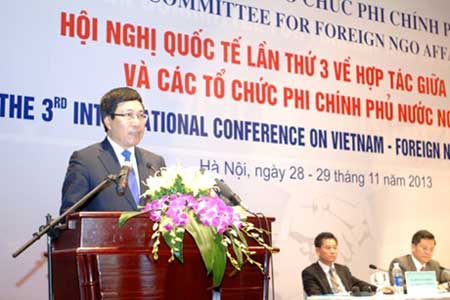
Vietnam and foreign non-governmental organisations (NGOs) have outlined directions for bilateral ties during thematic seminars in Hanoi on November 28 as part of the third international conference on Vietnam and NGOs cooperation.

Deputy PM, FM Pham Binh Minh attends the third International Meeting on cooperation between Viet Nam and NGOs, Ha Noi, November 28, 2013 - Photo: VGP
On education, both sides will focus on supporting teachers’ training in all levels, building education infrastructure system, education exchanges, assisting in foreign language training and providing voluntary teachers for specialised schools.

Also on the focus is the assistance in information technology for schools, especially those in rural, remote and mountainous areas, the intensive training for school students in social vices and the support in clean water and environmental sanitation at school.

Social issues will continue to be the cornerstone of cooperative projects with NGOs, focusing on poverty reduction, social welfares for children, the poor, vulnerable groups and ethnic minority people, and the enhancement of proactive engagement of local people as well as Vietnamese partners.

NGOs’ cooperation in environmental protection and climate change response will target the greater involvement of the private sector in emergency aid.

A seminar on the Agent Orange/Dioxin issues and support for the victims highlighted measures to further speed up the handling of AO aftermaths and improving the living conditions for the victims.

In another seminar on overcoming the consequences of unexploded ordnances in Vietnam, stronger cooperation mechanisms between Vietnam and the foreign NGOs were proposed.

Participants also shared their experience and lessons learnt in the field over the past years, while giving positive initiatives to better the work, thus eliminating the risk of losing lives to unexploded ordnances.

On vocational training and employment, connections between Vietnam and foreign NGOs will be centred on the training of vocational teachers and the transfer of modern training models.

During a seminar on health care, foreign NGOs suggested the Vietnamese side establish a healthcare working group to process their proposals and advices. They also proposed further simplifying administrative procedures and completing management mechanisms to manage and use their resources.

According to the Committee for Foreign NGO Affairs, Vietnam has established ties with around 950 foreign NGOs.

Over the past decade, NGOs have implemented more than 25,000 programmes, projects and aid packages totalling some 2.4 billion USD, with over 1.12 billion USD coming from North America, 813 million USD from Europe and more than 450 million USD from Asia-Pacific.

The assistance, which makes up 0.21 to 0.45 percent of Vietnam’s gross domestic product (GDP), has reached all 63 cities and provinces in the country.

Improving legal environment for NGOs

The Vietnamese Government committed to improving the legal environment to make it easier for Non-Governmental Organizations (NGOs)’ activities.

Deputy PM and FM Pham Binh Minh made the statement at the third International Meeting on cooperation between Viet Nam and NGOs in Ha Noi on November 28.

In the recent years, Viet Nam has gained a number of achievements following its renovation process, boosted the national industrialization and modernization, and improved the people's living standards and social welfare, the Deputy PM affirmed.

Thanks to successes in economic growth rate and social welfare, Viet Nam has fulfilled the United Nations Millennium Development Goals for poverty reduction earlier than scheduled, he added.

The proportion of poor households decreased from 13.7% in 2008 to 9.6% in 2012. The average income of poor households increased two folds over the past five years. In 2012, the number of poor households reduced 27.6% and the nation’s poor household proportion down 1.76% compared to 2011.

In external relations, the relationship between Viet Nam and other nations, international and regional organizations and NGOs have been expanded and diversified in the spirit of “Viet Nam-a reliable partner and a responsible member in the international community”.

Deputy PM Minh highlighted assistance of NGOs and international partners for Viet Nam and said he hoped that NGOs will provide more aid for Viet Nam in the future.

Priorities proposed at the meeting

Firstly, NGOs will strengthen effective cooperation in their potential fields to be suitable with Viet Nam’s demands and law.

Secondly, NGOs cooperate with Viet Nam’s agencies and localities to establish and launch realistic projects oriented to socio-economic development such as health and education services improvement, epidemic diseases prevention, social issue settlement, environmental protection, natural calamity reduction and the overcoming of wartime consequences.

Thirdly, NGOs expand their assistance by launching long-term projects and sustainable aid, increasing knowledge and skills for staffers working in fields of development and poverty reduction.

Fourthly, NGOs strengthen cooperative mechanisms with Viet Nam’s agencies and localities, especially the trilateral cooperative mechanism with local authorities and citizens.

Source: VNA